

Kickstart | Field Service Management Solution

Kickstart Blogs

Published: Oct 2026 · 7 min read

by Adam Scott

HVAC Scheduling and Dispatch: How to Manage Daily Service Calls Efficiently

Introduction

Managing daily service calls is one of the biggest challenges for a growing HVAC business. More customers mean more appointments to coordinate, more technicians to assign, and more routes to plan. Without an organized system, scheduling conflicts, delayed arrivals, and missed updates can quickly affect productivity and customer satisfaction. Understanding HVAC scheduling and dispatch is essential for keeping daily operations organized, helping technicians complete jobs efficiently, and delivering reliable service.

Kickstart helps HVAC businesses simplify field service operations by bringing job scheduling, task assignment, customer information, and invoicing into one connected platform. With a more organized workflow, HVAC contractors can manage daily service calls more effectively, reduce administrative work, and focus on providing quality service while growing their businesses.

hvac scheduling and dispatch

The Operational Challenges HVAC Businesses Face Managing Daily Service Calls

Most HVAC businesses handle the workload fine when the team is small and the call list is short. The challenges begin once call volume grows beyond what one person can coordinate through memory, phone calls, and a shared calendar. At that point, hvac scheduling and dispatch stops being a simple daily task and becomes the biggest factor in how smoothly the business runs.

Here is what growing HVAC businesses typically struggle with:

  • Emergency repair calls collide with planned maintenance and install appointments without a single shared schedule
  • Seasonal demand spikes in summer and winter increase call volume faster than manual scheduling can reliably handle
  • Technicians arrive without service history or job details because information is passed along by phone or text
  • Invoicing falls behind job completion as paperwork and administrative work increase alongside call volume
  • Business owners lose visibility into which technicians, job types, and services are generating the most revenue

Each of these challenges directly limits how efficiently and profitably an HVAC business can manage its daily service calls.

The Top Benefits of HVAC Scheduling and Dispatch for Growing HVAC Businesses

Understanding the core benefits of hvac scheduling and dispatch helps HVAC business owners see why a dedicated system is not an optional upgrade but the operational foundation that makes sustainable growth genuinely possible.

Benefit 1: Scalable Technician Scheduling That Handles Growing Call Volume

One of the most immediate benefits of dedicated HVAC scheduling and dispatch software is the ability to schedule a growing number of technicians across a growing number of service calls without losing organizational clarity. Emergency repairs, routine maintenance, and installs all compete for the same technician hours, and a shared system keeps them from colliding.

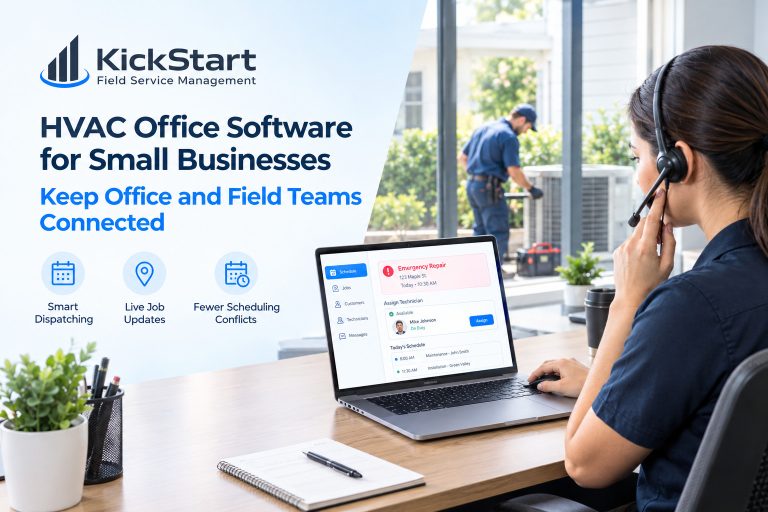
Kickstart provides a drag and drop scheduling interface that handles ten technicians just as smoothly as it handles two, giving office staff a clear view of every technician’s day regardless of how many jobs are running at once.

Benefit 2: Real Time Technician Visibility That Enables Faster Emergency

Knowing where every technician is throughout the day lets office staff respond faster to urgent requests, give customers accurate arrival estimates, and handle unexpected schedule changes without losing sight of the overall day. This matters most during heat waves and cold snaps, when emergency calls arrive faster than the schedule can absorb.

Kickstart provides live technician tracking, so dispatchers always have an accurate picture of each active technician’s location and job status. When a no-cool or no-heat call comes in, the closest available technician can be identified and redirected within minutes, rather than through a series of phone calls that interrupt technicians in the middle of active jobs.

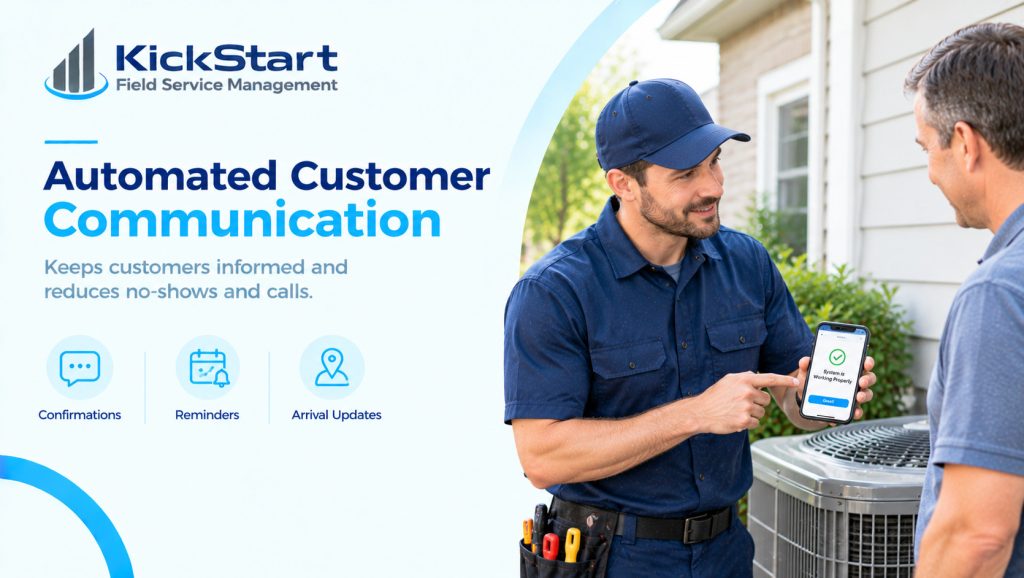
Benefit 3:Automated Customer Communication That Reduces No-Shows

Customers want to know when a technician is coming, and they will call the office to ask if they aren’t told. Every “where is my technician?” call pulls office staff away from scheduling, and every missed appointment wastes a slot that another customer could have used.

Kickstart automates customer communication so confirmations, reminders, and arrival updates go out without anyone on the team sending them by hand. Customers stay informed, no-shows and last-minute cancellations drop, and the office spends its time managing the day instead of answering status calls.

Benefit 4: Clear Job Records That Keep Technicians and the Office on the Same Page

When job details are passed along by phone or text, technicians arrive without the full picture and the office has no reliable record of what was done. A shared system keeps the reason for the call, the customer’s service history, and the job status in one place, so everyone is working from the same information.

Kickstart keeps each customer’s jobs and service history connected to the schedule, which means dispatchers assign work with context and technicians can follow a consistent process from job to job.

How These Benefits Compound as the HVAC Business Grows

The benefits of hvac scheduling and dispatch do not simply add up linearly as a business expands. They compound in ways that become increasingly valuable the larger and busier the operation becomes over time.

Better scheduling creates capacity for more service calls without adding technicians right away. More completed calls generate more revenue, and that revenue gets collected faster through instant invoicing. Faster collection funds investment in new vehicles, equipment, and technicians who can serve more customers. Stronger customer retention through automated communication turns one-time repairs into recurring maintenance customers, which reduces the marketing spend needed to keep revenue steady.

For HVAC companies, this effect is even stronger because of seasonality. A business that handles the summer and winter rushes smoothly, without missed appointments or billing backlogs, enters the slower months with healthier cash flow and happier customers who are more likely to book maintenance plans.

This compounding dynamic is why HVAC businesses that adopt the right software early tend to grow faster and more profitably than those that wait until manual processes have already become a serious obstacle to further expansion.

Conclusion

The benefits of hvac scheduling and dispatch for growing HVAC businesses extend far beyond basic scheduling convenience. They touch every part of the operation, from technician coordination and emergency response to customer retention and cash flow management.

For HVAC companies serious about handling more service calls without losing quality or consistency, dedicated software is the operational foundation that makes sustainable growth possible season after season. Kickstart gives growing HVAC businesses the complete platform needed to realize every one of these benefits within one connected system.

FAQs

Prioritize by safety and urgency first: gas smells, no heat in freezing weather, and electrical or refrigerant hazards come before no-cool calls, and those come before routine maintenance. Within the same urgency level, send the closest qualified technician. If a planned appointment has to move, tell that customer right away and offer a new arrival window.

Set up an on-call rotation so one technician is responsible for each night or weekend. Agree in advance on what counts as an emergency, and use a written process for recording call details and notifying the on-call technician. This keeps after-hours dispatch consistent and prevents missed calls.

Contact the next customer as soon as you know about the delay and offer a new arrival window. If another qualified technician is nearby, reassign the job. Over time, track which job types often run long and allow more time for them when scheduling.

Track on-time arrival rate, jobs completed per technician per day, the time between a call coming in and a technician arriving, and the percentage of jobs needing a second visit. Reviewing these monthly shows where your hvac scheduling and dispatch process is working and where jobs are delayed or repeated.

Yes, once the schedule becomes hard to manage by memory, phone calls, or spreadsheets. Warning signs include double-booked technicians, missed appointments, and invoices going out days after the work is done. Kickstart is built for small trades teams, with crew scheduling, live technician tracking, and instant invoicing in one platform.

related Posts

HVAC Office Software for Small Businesses: Features Every Team Needs?

Kickstart Blogs Published: Oct 2026 · 7 min read by Adam Scott HVAC Office Software for Small Businesses: Features Every...
Read More →

HVAC Scheduling Programs That Improve Daily Service Operations

Kickstart Blogs Published: Oct 2026 · 7 min read by Adam Scott HVAC Scheduling Programs That Improve Daily Service Operations...

Read More →

Business HVAC Software: How to Manage Your HVAC Company in One Place?

Kickstart Blogs Published: Oct 2026 · 7 min read by Adam Scott Business HVAC Software: How to Manage Your HVAC...
Read More →
→ Index